
You are probably tired of hearing this: your hotel needs to personalise the guest experience. From pre-booking marketing to post-checkout surveys, everything must align with your guests' tastes and preferences. Personalisation is no longer an optional extra; it is a necessity.
Message received. But what does this actually mean? And where and how do you start?
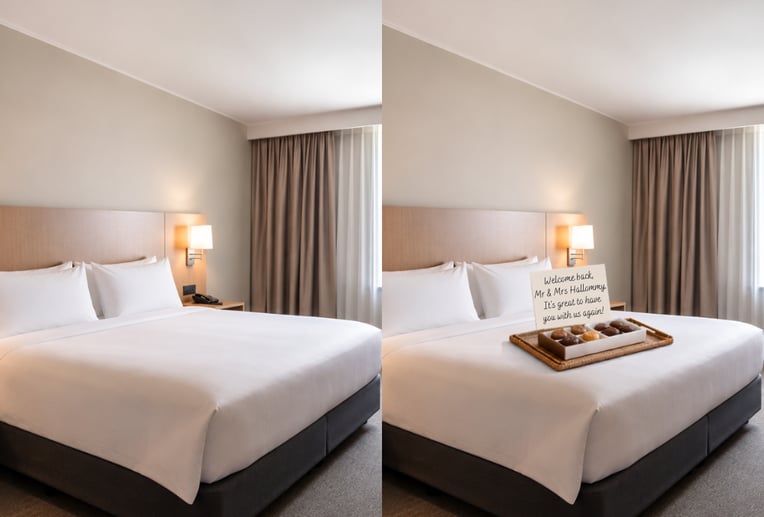
As a hotelier, achieving a high level of personalisation—which means knowing far more than just the guest’s name—is essential for staying competitive in today's rapidly evolving market. In this article, we’ll explain the first practical steps towards delivering that sought-after personalised touch that will delight your guests and boost your revenue simultaneously.
What does personalisation mean in the context of hospitality?
‘Personalisation’ is a broad term, but at its core, it simply means treating every guest as an individual. It’s about recognising that their needs, desires, and expectations are unique, whether you’re dealing with a first-time website visitor or a frequent guest like Ms Jenkins (hopefully her cat’s ear is feeling better). True personalisation goes far deeper than addressing a guest by name; it’s about anticipating their specific preferences and tailoring their experience accordingly.
Fortunately, the hospitality industry has become increasingly data-driven. Thanks to technological advances, hotels now have access to a wealth of guest data that allows you to analyse behaviour, segment your audience, and tailor your marketing and operational efforts with precision. This shift means personalisation is no longer a luxury, but an operational necessity, supported by an array of tools to help you collect and leverage these insights effectively.
Hyper-personalisation and AI
While knowing the purpose of a guest's trip or their age group already reveals a lot about their expectations, AI and machine learning have unlocked a level of customisation so precise that many experts now call it 'hyper-personalisation'. Hotels can now predict guest preferences based on past behaviour and offer highly targeted recommendations. This could include suggesting dining options tailored to dietary requirements or offering late check-out for corporate travellers with evening flights.
What was once mere segmentation can now become personalisation in its truest sense: catering to the individual. Rather than grouping guests into broad categories based on demographics like age, origin, or gender, hyper-personalisation in hospitality considers specific preferences, past behaviours, and current needs to deliver real-time, tailored experiences, services, and promotions.
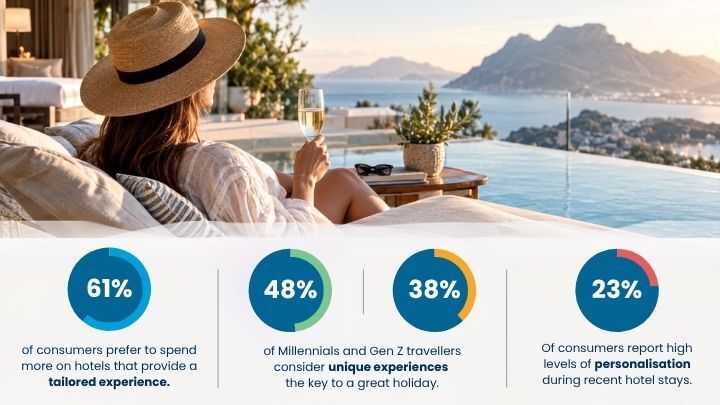
The effort put into personalising your hotel's services can deliver substantial returns.Research indicates that 61% of consumers are willing to spend more with companies that provide a tailored experience. Moreover, according to HotelMize, 48% of Millennials and 38% of Gen Z travellers consider a unique experience the most important element of a great holiday.
However, the Medallia research revealed that only 25% of consumers feel they have experienced high levels of personalisation during recent hotel stays. That shows that only a small number of hotels have adopted AI-driven one-to-one personalisation.
This presents a significant opportunity: by mastering the fundamentals of personalisation, you will be perfectly positioned to outperform competitors and boost revenue. Let’s explore the practical steps you can take to make this a reality.
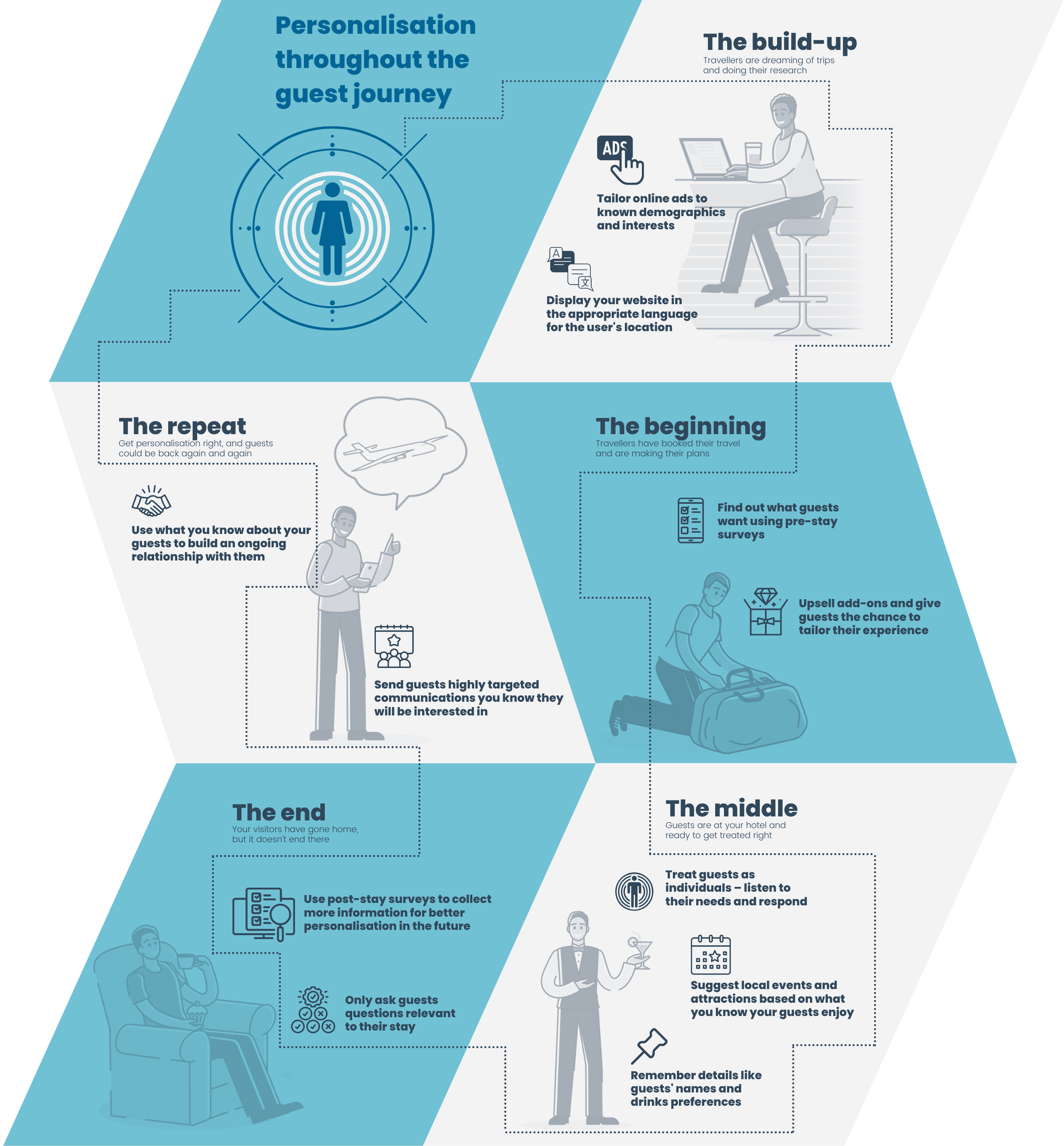
Personalisation at different points in the guest journey
The build-up
For prospective guests you haven't yet met, personalisation begins with creating relevant digital touchpoints, such as displaying your website in the user's local language or tailoring online advertisements to align with their specific demographics and interests. Even though these visitors may be anonymous, treating them as a distinct audience rather than a homogeneous group creates a more welcoming and relevant first impression.
This phase of the journey should become even more sophisticated for returning guests. Whether they have stayed at your property before or are visiting another hotel in your group, data recognition is non-negotiable.
If travellers have previously shared their information with you, they expect to be recognised; failing to do so can quickly create a sense of disconnect. Use this opportunity to refine your hotel’s segmentation strategies, moving away from generic mass emails to deliver tailored marketing campaigns. By crafting exclusive promotions, personalised emails, and custom content that resonate with specific segments, you can significantly increase engagement and drive bookings.
Beyond communication, operational flexibility is a vital form of personalisation. Reward repeat guests with tangible perks like room upgrades or exclusive services based on their known preferences. By analysing booking patterns, you can create customised packages that deliver real value to your guests.
Finally, remember that convenience is a preference; offering flexible booking policies and non-traditional service schedules such as all-day dining, late breakfasts, or contactless check-in options shows you have anticipated guests’ needs long before they set foot in your hotel.
The beginning
Once a guest has completed their booking, the window of opportunity to initiate personalisation opens. While the execution will naturally vary between a five-star luxury property and a budget inn, the fundamental principle remains universal: early engagement builds anticipation.
At this stage, many hotels send a pre-stay questionnaire to gather the specific details needed to tailor the upcoming visit. Asking directly is the most effective way to learn what guests truly value. Whether it is a pillow preference, minibar customisation, or a request for a quiet room on a specific floor, these “small touches” help guests feel at home before they even arrive.
However, a word of caution: asking for preferences and failing to deliver on them is a significant misstep. It is far better to claim ignorance than to demonstrate indifference.
More than gathering data and stay preferences, pre-stay communication is your chance to add value. Send personalised emails or messages containing local insights—such as weather updates, cultural events, or dining tips—that align with your hotel’s style and price point. This is also the ideal moment to offer targeted upgrades, such as spa treatments or curated excursions.
When personalisation is executed effectively, it transforms sales into a genuine service; by offering relevant extras, you not only enhance the guest experience but also drive incremental revenue.
The middle
Gathering guest details before arrival enables staff to elevate personalisation upon meeting guests in person. If your concierge knows in advance whether a guest is travelling for business or leisure, or as a family or couple, they can tailor their assistance immediately. Some hoteliers even review guests' public social media profiles to gain insight into their interests and preferences.
Managers should be trained to respond to guests as individuals; they should listen to their needs and respond accordingly. During a stay, personalisation does not rely solely on complex technology and data collection. Simple touches like staff remembering a guest's drink preferences represent a timeless form of hospitality that requires no mobile app. This approach creates an emotional and trusting connection with a staff member, which extends to the hotel brand.
Knowledgeable concierges can help guests create bespoke itineraries by discussing their interests and recommending suitable local attractions. Alternatively, pre-stay questionnaire responses can be used to curate tailored recommendations or brochures, such as culture, heritage, or outdoor adventure guides.
Staying informed about local events also helps staff suggest unique, memorable experiences for your guests. Although technology has propelled personalisation to the forefront, with smartphones, apps, and big data underpinning many hotel initiatives, treating guests as individuals is not dependent on expensive tech. Regardless of how you gather guest insights, travellers will recognise and appreciate the effort taken to understand them.
Ultimately, all your personalisation efforts should aim to deliver memorable experiences worth sharing. Technology can be a powerful ally here: AI can efficiently handle routine housekeeping requests or service queries, freeing your staff to focus on high-value human interactions.
The end?
Personalisation (and the data collection that facilitates it) certainly shouldn’t end after check-out. Sending guests feedback questionnaires to find out what worked for them and what didn’t should be an integral part of the guest communication process, and these questionnaires, like everything else, can be personalised. You should only be asking guests questions relevant to them – if your guest didn’t use the spa, don’t ask her about it. And remember that all of this data can be collected and used to further personalise guests’ future stays at your hotel (or other hotels in your group).
Beyond driving operational improvements and personalised services, reviews serve other crucial purposes in today's AI-driven landscape. Besides acting as social proof for potential guests, reviews are now vital data signals for AI tools. These systems analyse the sentiment and specific content within your reviews to determine whether your property matches a traveller’s unique needs, directly influencing whether your hotel is recommended to them.
In an episode of the Back of House Banter podcast, Adam Hamadache, CEO of Formula Digital, explains how AI can provide hyper-personalised hotel recommendations by collecting specific information from guest reviews to match a traveller’s needs: “They (guests) will be sharing with the AI what is important to them.” He continues:
The way LLMs, Large Language Models, will be able to find this information, most notably, it will be within the reviews. If they (guests) are constantly commenting on the noisiness of other guests from their experience, that’s going to be pulled up.
Adam highlights that whether information is on a hotel’s website is no longer crucial. AI gathers data from across the web to inform recommendations: “LLMs can see everything that’s ever been said and the recency of when it’s been said, and then be able to determine: 'Actually, don’t stay at this hotel because a lot of guests say it’s quite noisy, but this hotel, lots of guests are saying it’s really quiet.'”
The repeat
Once a guest has stayed at your hotel, it is not the end of your relationship with them. In fact, many industry leaders believe that personalisation is one of the few remaining ways to encourage guest loyalty and repeat visits that actually still works.
All the information you have collected about your guest – his demographic information, likes, dislikes and interests – can be used post-stay to strengthen your connection with your guests, to market your hotel in a more targeted, personal way, and to encourage repeat visits, social media engagement, and loyalty. Hotel loyalty is no longer about generic perks and discounts; it’s about the guest’s relationship with your brand, and the only way to build a relationship is to treat guests as individuals.
Getting started with personalisation
One of the foundational tasks in a personalisation strategy is figuring out which parts of your hotel experience can be standardised and which should be personalised. Hotels tend to go to one extreme or the other, pouring time, money and human resources into investigating each and every guest and tailoring every aspect of their stay, or expecting all guests to be satisfied with a one-size-fits-all approach.
Analysing your current resources, especially any data and technology you aren’t using to the fullest, and deciding what types of personalisation you can implement with what you already have is often a good place to start. Relying on feedback from guests to let you know what is positively impacting their experience and what isn’t as impressive will help guide your personalisation efforts, and help you to find a balance between personalisation and standardisation, and between technology and real-life interpersonal hospitality experiences.
If you do decide to invest further in enhancing personalisation in your business, you will probably find that technology that allows you to collect, store and retrieve data will provide the best return on investment. Make sure, however, that your different systems (such as guest feedback, customer relations management and property management systems) are integrated with one another, so that all data collected can be used in the future to personalise guest communications and experience.
If you do decide to invest further in enhancing personalisation in your business, you will probably find that technology that allows you to collect, store and retrieve data will provide the best return on investment. Make sure, however, that your different systems (such as guest feedback, customer relations management and property management systems) are integrated with one another so that all data collected can be used in the future to personalise guest communications and experience.
Once you have begun to implement procedures, you need to make sure that your personalisation efforts are paying off. You need to constantly be asking your guests, and yourself, if the personalisation efforts you have in place are worth the human resources and financial costs.
Personalisation needn’t be rocket science; it’s about treating your guests (past, present and prospective) like people rather than paychecks, and providing the kinds of experiences that make memories.