
We all know that guest insights are what shape a great hotel experience. Understanding what guests love, what could be better, and what makes a stay truly memorable can transform the way you operate. The tricky part, of course, is getting those insights in the first place. Often, the simplest way to find out what guests think is just to ask, and guest surveys remain one of the easiest and most effective ways to do that.
The problem is that too many surveys feel long, dull or impersonal. Guests open the email, see a list of generic questions, and quickly close it as if it were some kind of virus. For most hotels, usually only one in five guests completes a survey. That means if your response rate is around 18–22%, you’re not failing – you’re normal. The interesting question is what nudges you out of that middle pack.
We analysed post-stay surveys sent in 2025 by more than 1,500 hotels to get a clear understanding of what works and what does not in real hotel environments.
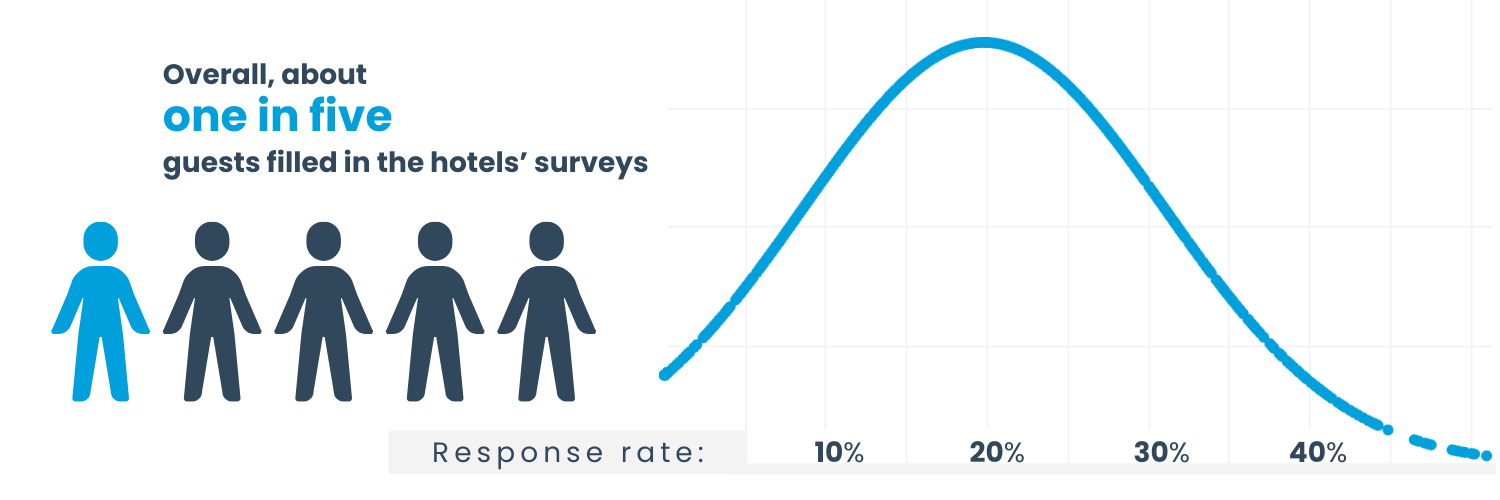
With the right approach, surveys can feel effortless and personal while still giving you the insights you need to improve the guest experience.
Craft a Compelling Invitation
Getting useful feedback starts with a great survey invitation. But before anything else, make sure you are sending your invitation to the right email address, because no one can answer your email if it ends up at nobody@nowhere.com.
The subject line is also crucial. It is the first thing guests will see, so keep it friendly and personal. In our dataset, subject lines under five words had the highest response rates at 23 per cent, while long subject lines of 11 words or more performed worst at 17 per cent.
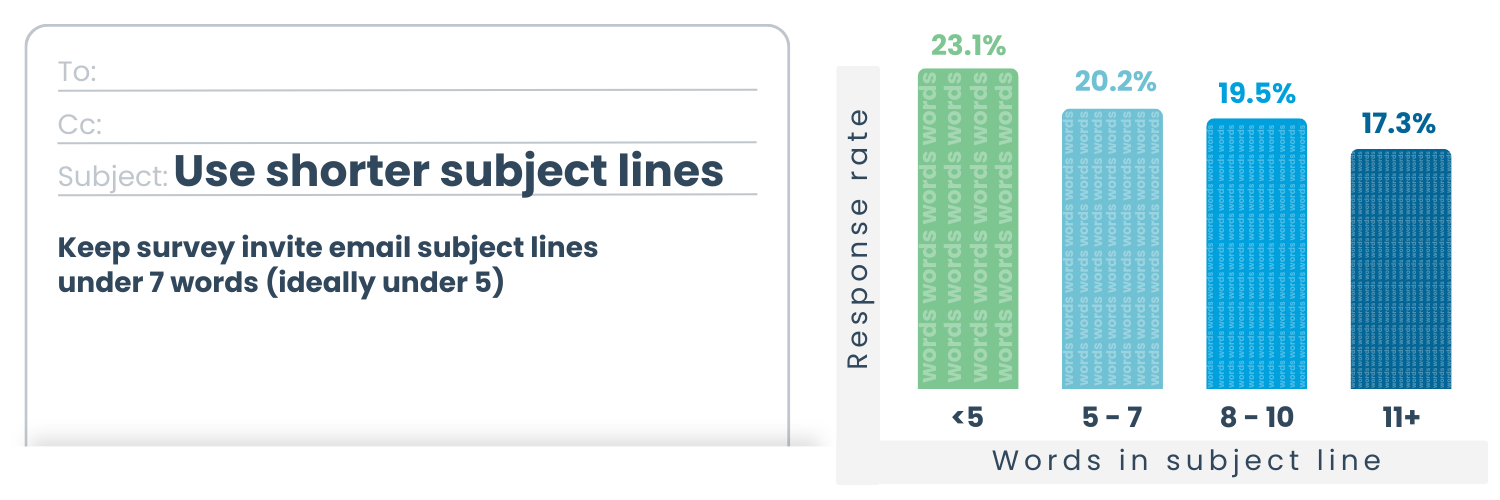
Using the guest’s first name in the greeting makes it feel even more personal, and phrasing such as “How was your stay at [Hotel]?” performs significantly better than generic “visit” wording. Keep the tone of your email in line with your hotel’s personality and sign off with a real name, for example, “Yours sincerely, John Smith, General Manager, Langdon Hotel”. If you know your guest’s preferred language, sending the email in that language makes the process even smoother and shows that you really care about your guests. A personal, clear and inviting email will encourage guests to share honest and useful feedback.
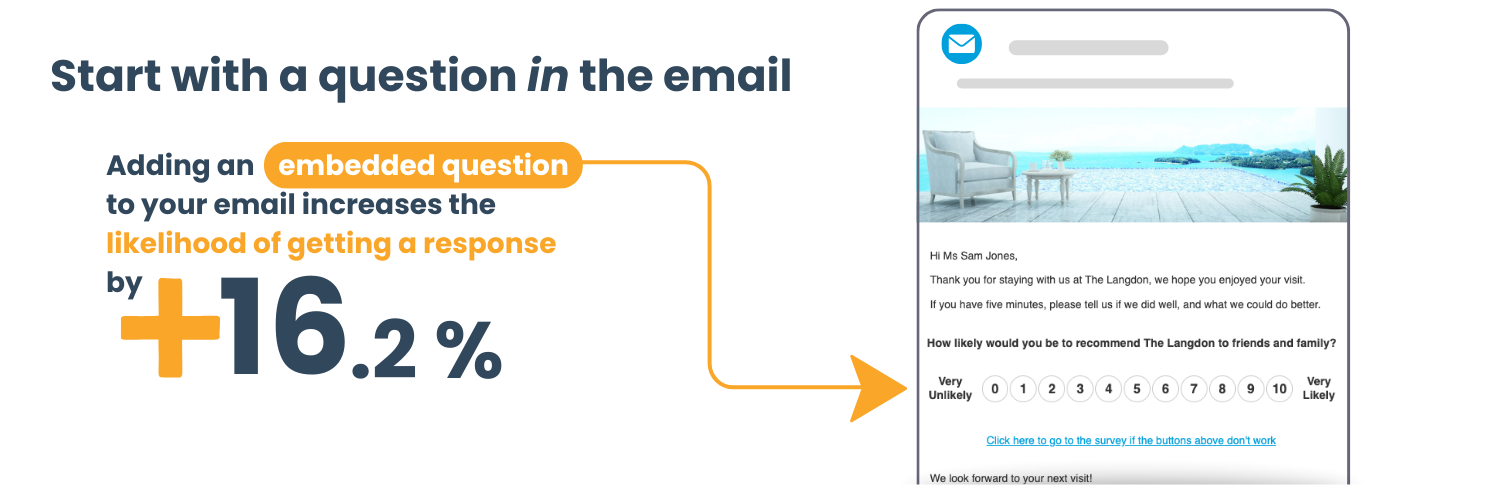
To get guests engaged straight away, you should include one of the survey questions directly in the email. In our data, surveys with an embedded first question saw response rates rise to 22.7 per cent compared with 19.6 per cent for those without. This small change makes it easier for guests to begin, and provides a 3 percentage point uplift, which is a meaningful gain given the overall average of around 20%.
If you want to get the most out of your surveys, here is a closer look at GuestRevu’s tips for optimising your survey invitation emails.
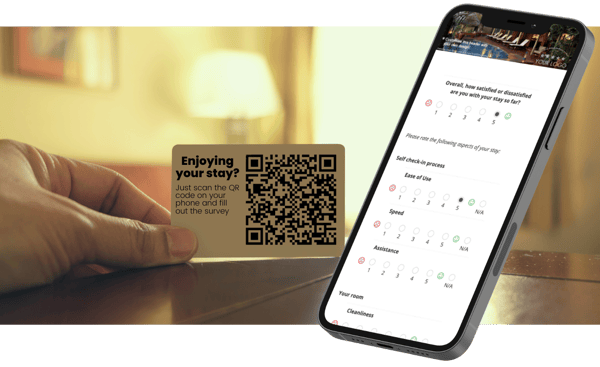
Email invitations aren't the only way to deliver surveys. You can also use strategically positioned QR codes, or send your survey links via text message if you've got a guest communications tool like HiJiffy.
Make It Personal
Guests have just spent time and money at your hotel, so your survey should feel like a friendly chat, not like they are filling out a tax return. Using their name, referencing something specific from their stay, or highlighting a feature they enjoyed makes the questions feel personal and engaging. Instead of “Rate the breakfast,” try “Which breakfast dish made your morning?” Rather than “How was check-in?” ask “Did our team make your arrival smooth and easy?”
When guests sense that the survey is personalised and friendly, they are more willing to respond. Clear, considerate wording creates a better experience, encourages participation and produces richer insights that reflect their true impressions of your hotel.
Ask Questions That Matter
Before drafting questions, think about why you are sending the survey in the first place. Are you curious about the new menu, a refurbished lobby, or just the overall guest experience? Every question in your survey should have a purpose and give you insights you can actually use. Keep questions short, clear and relevant to the guest’s experience. For example, don’t ask “How was the honeymoon suite?” if the guests were visiting for a bachelor's party. Ask something that matters, like “What did you enjoy most about the bar area?”
Consider asking an overall impression or Net Promoter Score (NPS) question first, followed by context questions such as whether the trip was for business or leisure, or solo versus group travel. These details help you segment responses later and make the survey feel relevant.
Mixing question types keeps the survey interesting. Ratings, multiple-choice and open-ended questions work together to give you both numbers and personal stories. Open-ended questions are particularly useful because they often reveal insights you would not have considered, from small details about a favourite breakfast dish to comments on the friendliness of staff.
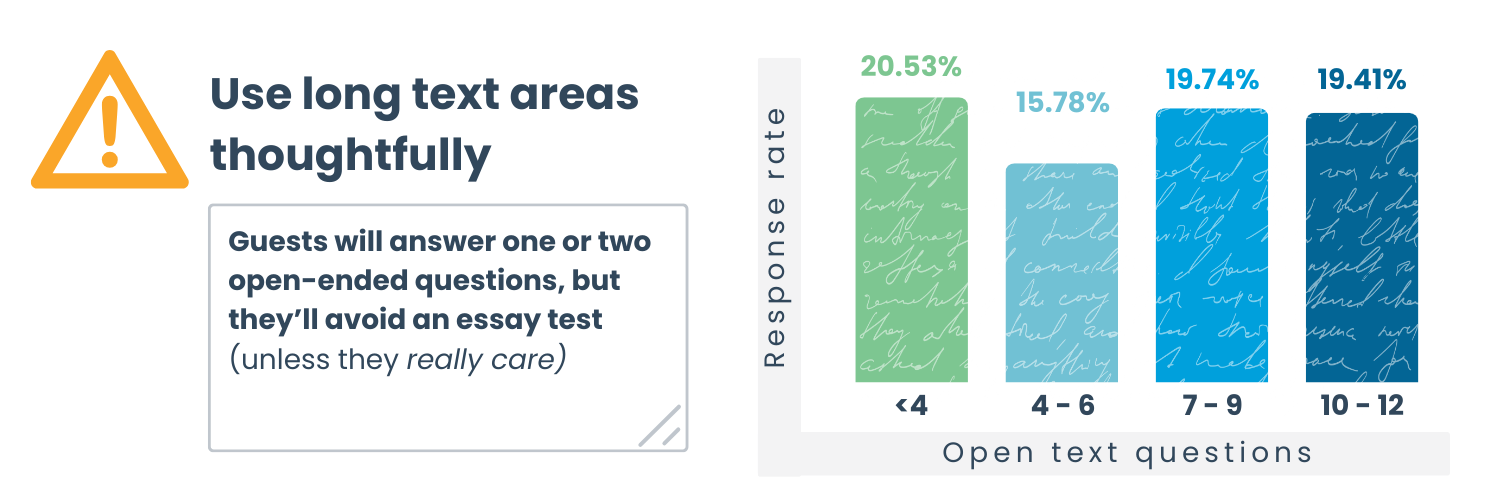
From our analysis, one to three open-ended questions performed well, with response rates around 20 to 22 per cent, while surveys with six open-ended questions saw response rates drop to about 14 per cent. Guests are willing to write a little, not a lot.
Tracking your survey over time is also useful. It shows which questions are working, highlights trends, and helps identify areas where you might need to make tweaks. Keeping questions purposeful and relevant ensures that the feedback you gather can be turned into meaningful improvements.
Keep Surveys Simple and Logical
Long surveys can feel never-ending, and studies have shown that questions at the end of a survey often get rushed, answered in just a few words, or skipped entirely. Research suggests the ideal length for an online survey is between 10 and 15 minutes, with a maximum of 20 to 28 minutes. But our real-world data tells a more nuanced story.
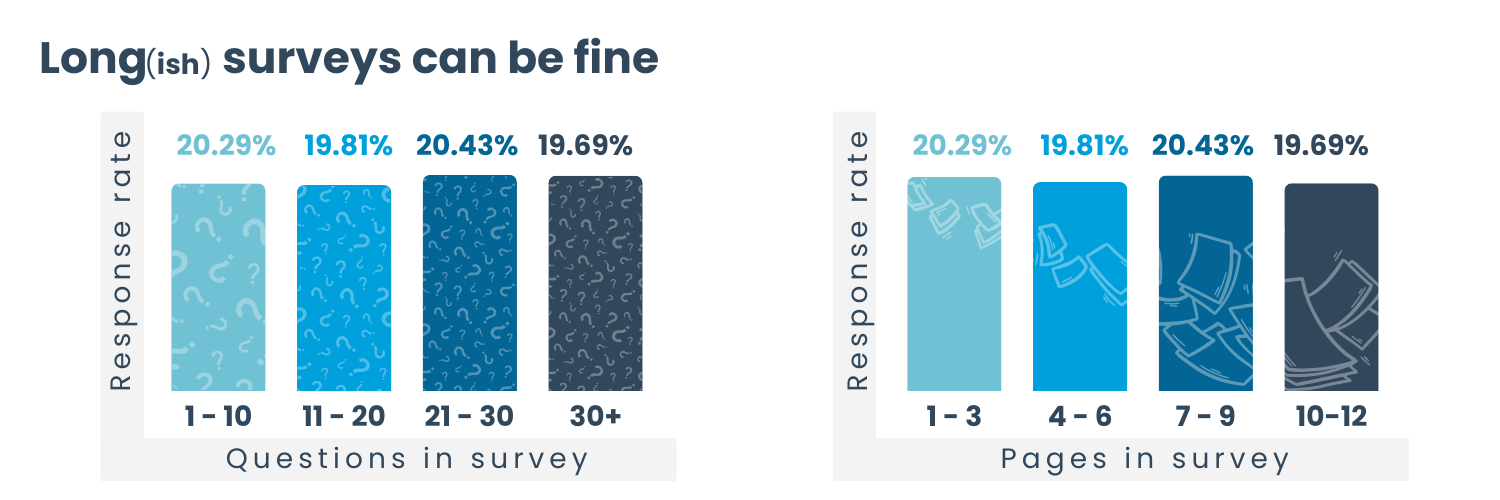
Across more than 1,500 hotels, most surveys contained 11 to 30 questions, and performed almost identically, with response rates around 19 to 20 per cent. Although very short surveys performed slightly better, there was no clear penalty for longer surveys within reasonable limits, and in a few outlying cases, very long surveys performed better, likely due to highly engaged guests.
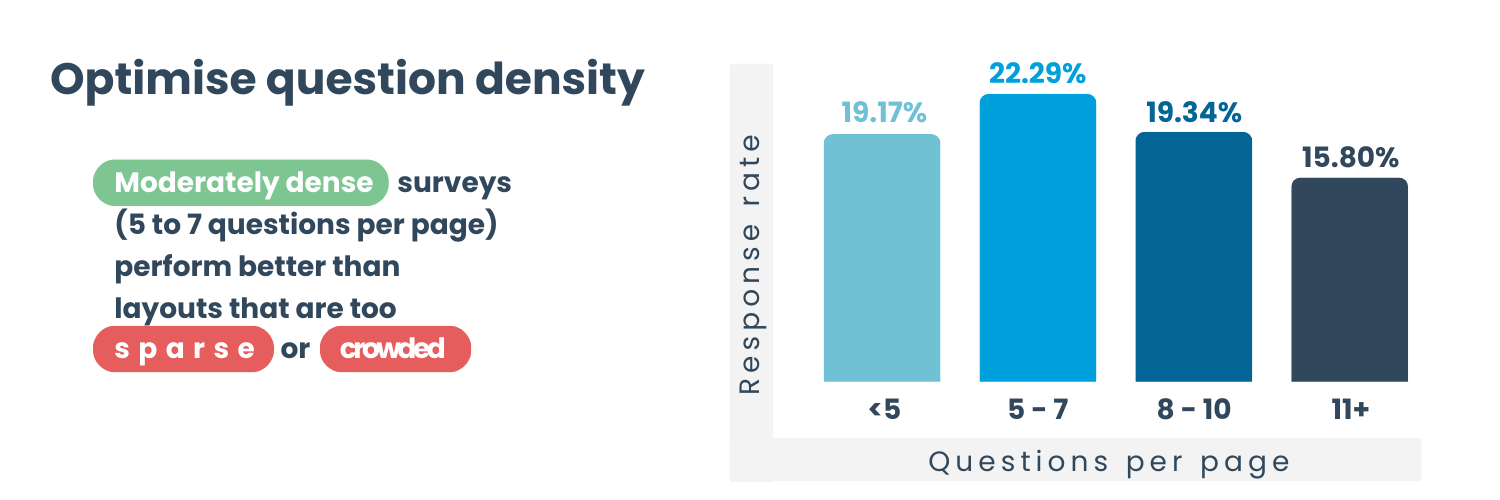
What's more important than the number of questions asked appears to be how many pages the survey is, and how many questions there are per page. Our data showed the sweet spot tends to be a survey 1-3 pages long, with 5–7 questions per page.
When guests know a survey is well thought out and logical, they are much more likely to complete it and give thoughtful feedback. Place open-ended questions near the start, when guests are fresh and willing to share detailed thoughts.
Survey Design Matters
Visual design is just as important as the questions you ask. If a survey looks bright and inviting, your guests are much more likely to answer it than if it looks like a dull and boring chore. But designing your survey often means finding the right balance between your brand’s look and feel, what’s appealing to guests, and what design yields the most accurate results.
Research from Utrecht University found that different designs can influence responses.
Hearts and stars: While aesthetically appealing, these formats tended to result in lower average scores compared to other formats.
Smileys: Produced scores similar to traditional radio buttons, and respondents said they liked these designs. Smiley or frowny faces might also make surveys more enjoyable and help speed up mental processing for respondents.
Grids: Viewed less favourably overall from a design perspective, though the study found that grids can sometimes lead to higher average scores. “We found that grids have higher average scores than designs without grids […] This is in line with visual heuristics, in particular the ‘Middle Means Typical’ heuristic.”
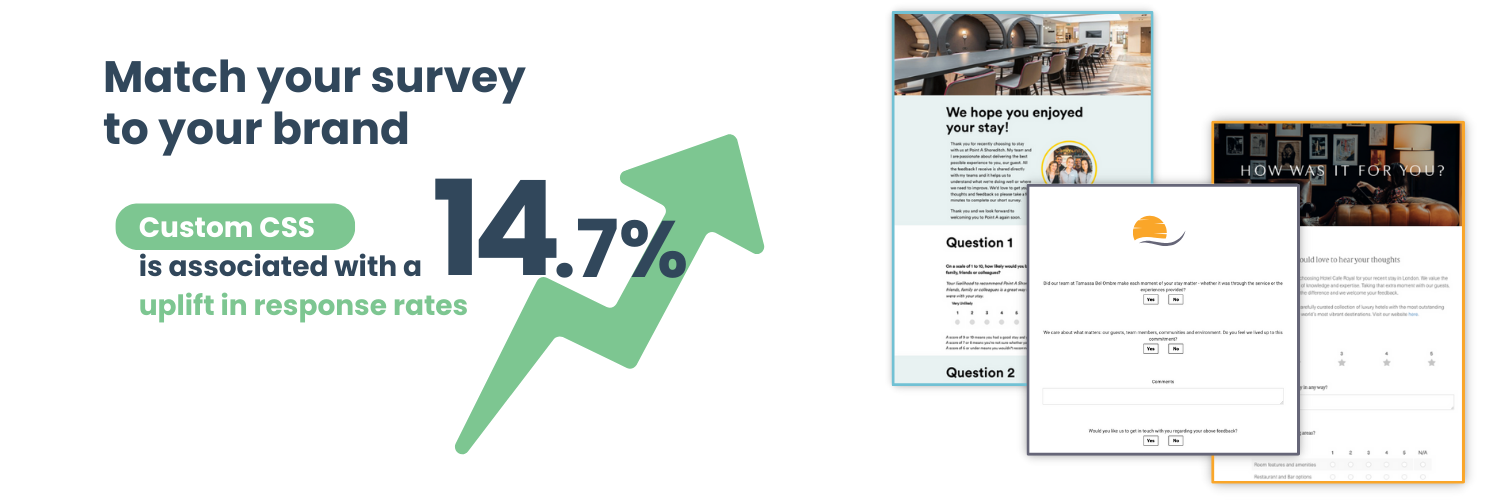
Our own data adds another layer: Branding matters too! Response rates for surveys styled with custom CSS averaged 22.3 per cent, compared to 19.4 per cent for unbranded versions. When a survey looks genuinely like part of your hotel’s communication, guests trust it more and engage more readily.
Design for Both Mobile and Desktop
When you are conceptualising the perfect survey design, remember that some guests will be answering on large desktop screens when they get back to the office, while others will be responding on their mobile phones during a train journey. You need to create a survey that works well on both devices without skewing the data depending on which device the guest uses.
One study found that big grids can slow people down, especially on phones, and can lead to longer completion times. Another found that using sliders resulted in more negative results, and they are more frequently skipped on mobile phones than on desktops.
Showing one question at a time, rather than placing multiple questions in a table, can make the survey feel simpler and more comfortable for guests to complete. The modern rule of thumb for mobile design is that inputs and buttons should be large enough to press easily with... a thumb.
However, the limited space on mobile screens means that 11-point scales, such as the NPS, should be used sparingly. While desktop users tend to prefer 11-point scales and skip them less often, they are almost impossible to display horizontally on a mobile device.
Responsive design requires careful thought about how your survey will look and feel on different devices and the trade-offs needed to ensure it works for the largest number of guests. While our own dataset does not break down responses by device type, we see strong performance from surveys with clean layouts, moderate page lengths and simple structure, all consistent with mobile-friendly design principles. A clean, easy-to-use design makes it far more likely that guests will answer thoughtfully and provide useful feedback.
Turn Feedback into Action
A survey is only useful if you actually do something with the answers. Combine NPS scores with insights from open-ended questions and look at different guest types, lengths of stay, or reasons for visiting to spot patterns that simple ratings cannot show.
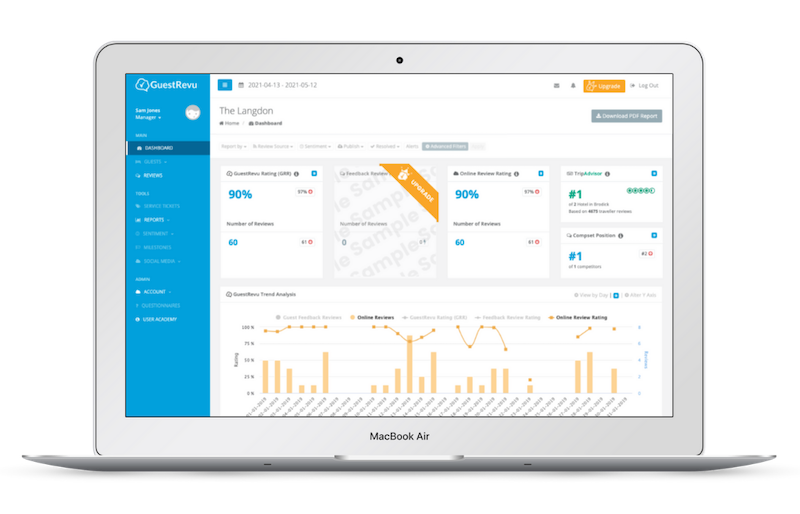
Tracking feedback over time shows what works and highlights areas for improvement. Open-ended responses are full of insights, and GuestRevu’s AI tools can help make sense of them. These tools take large volumes of survey responses and online reviews and turn them into clear themes, keywords, sentiment scores, and action points.
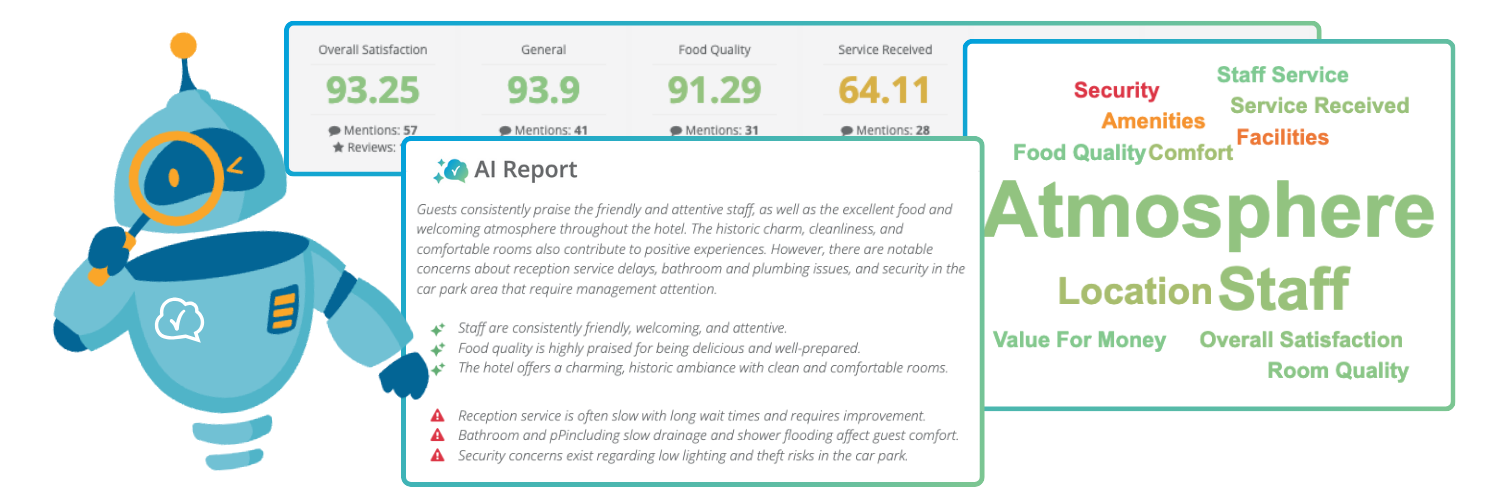
That way, you can quickly see what is working well and where you might need to improve without wading through endless comments (or asking guests for several essays on each aspect of their experience). Analysing and acting on feedback transforms routine surveys into a powerful tool for improving guest experience and staff performance.
Conclusion
An engaging survey is more than a list of questions. It is a genuine conversation with your guests, a chance to show that you value their time and truly care about their experience.
Our data shows that even the smallest design choices can have a meaningful impact. A shorter subject line, a thoughtfully placed open question, a clear page structure, consistent branding and an easy first step all help guests feel more comfortable and more willing to share their thoughts.
Take a moment to look at your current survey. Could it feel more personal, simpler to complete, or more closely connected to your brand? With a little attention and the support of real industry insights, your survey can become something guests are happy to complete. In return, you gain the kind of honest, valuable feedback that helps you create even better stays for every future guest.