
Novacancy has long been a staple of the hospitality calendar in Australia, so the GuestRevu team were delighted to head to the first London Novacancy.
For me, the highlight of the event was the content. The talks were informative, engaging, and provided a useful gauge of the current state of hospitality – and where key players think it might be heading next. This perspective was based on the decisions hoteliers are currently making regarding technology, distribution, revenue management, brand positioning, and people.
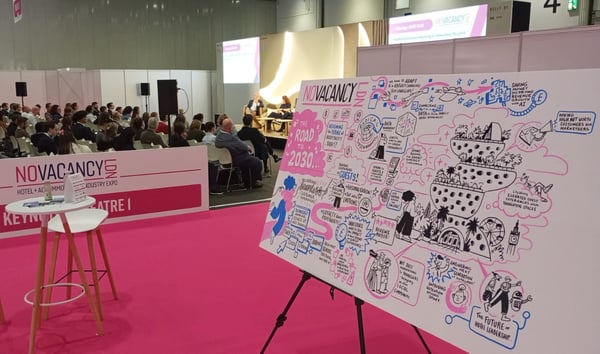
Across the talks I attended, a few themes were consistently repeated:
-
Although the systems, software, and AI-powered tools might be developing rapidly, hospitality is definitely still a people-first industry.
-
There is a vast amount of very mediocre content on the internet, and a lot of it is AI-generated. Meaningless, generic flotsam in a “sea of sameness” (see below) has never been helpful to anyone, but the sheer volume of it is becoming a barrier to guests, other businesses, and even to AI.
-
The best way forward doesn't seem to be the most automated and tech-savvy, nor the most steadfastly traditional. The hoteliers who do the best will likely be those who measure the metrics that actually matter, and make decisions based on a clear, consistent understanding of what makes their hotel successful as a business and delightful for guests
There were too many sessions to attend them all (especially as the conference was full of familiar faces and distractingly interesting ad-hoc conversations), but here are some key takeaways from the sessions that particularly stood out:
Travel Trade Tech vs Hospitality Humans
Technology at Novacancy was ubiquitous; most of the stands were tech vendors, and many of the talks inevitably circled back to topics like software, automation, and online marketing. But tech was not the star of the show. Leaders in the hospitality industry are becoming increasingly steadfast in the conviction that, as Lionel Benjamin, CEO at Gullwing Hospitality, so eloquently put it in the opening keynote, “We’re still always going to be a people-led industry… but… we need to be tech-enabled.”
Thomas Greenall, CEO at Bespoke Hotels, echoed this sentiment, saying his strategy is to “automate process, protect emotion”. How that looks will depend on what kind of emotion the hotel wants to elicit, whether it's a business-traveller city stay hotel or an ultra-luxury boutique.
The importance of the human element of hospitality can’t be overstated. In her talk about crafting the PIG Hotels’ brand, Lotti Bruce reminded the audience, “the senior leadership, the founder, whoever is at the helm, can create the concept, but the guest remembers the experience created by those on the ground – by our team.”
This sentiment was mirrored by Kalindi Juneja, CEO at PoB Hotels, who said, “that Instagrammable design moment will get you that first visit, but service and substance will be what gets you your second visit. You have to earn that second visit. It just doesn't come automatically.”
The right technology for a hospitable, human hotel
That’s not to say the people working in hospitality don’t need the right technology to deliver excellent experiences. “A hotel is a lot like a theatre,” explained Andrew Evers, VP of Technology at Rocco Forte Hotels, likening the front of house team to the actors who connect emotionally with the audience, but the tech to the lighting, sound, and all the other elements that go into creating the experience. “Whilst the actors are on stage doing their thing, there's a whole bunch of stuff going on at the back which the audience does not see, but without that, the production cannot happen,” he reiterated.
Leaders throughout the industry appear to be dissolving the boundary, though, between purely tech functions that operate in isolation from the guest and the “real” hospitality staff who create the memories. “We stopped saying ‘guests at the hotel’, and now I say ‘my guests’,” Andrew emphasised, illustrating just how important the spirit of hospitable hospitality and guest centricity really is, even in the tech roles.
I think that’s possibly why so few hospitality businesses find success with generic, albeit excellent, technology designed for industries and businesses outside of hospitality. There’s an intangible but very important hospitality ethos that tech partners have to understand to work effectively for hoteliers.
So how do hoteliers find tech that will work for their business? Kalindi had a few really practical suggestions:
-
Buy tech that talks to each other. “I think the issue tends to be in our industry … is that we're taking on one piece of kit and adding another and another and another and they're not talking to one another,” she explained.
-
Ask vendors what their roadmap looks like. “When you are talking to someone who is selling you a piece of kit, it's worth actually looking at and asking them what's your timeline for the next 5 to 10 years, because tech's changing rapidly,” suggests Kalindi.
-
Ask other hoteliers and peers for their insight into what's actually worked. “I think as an industry we can all do a lot more to help one another, to talk to one another […] I think, as hotel owners, let's not be shy. Let's pick up the phone, let's talk to our peers.”
Finally, as a bonus suggestion for really staying ahead of the curve, Kalindi suggests hoteliers look outside hospitality. “I actually focus on retail”, she revealed, “I think in many ways retail's really ahead of the game. We tend to adapt what they're doing, sort of 4 or 5 years later.”
e-commerce sites do images really well. What can hoteliers learn from them?
AI Slop vs Actual Authenticity*
The quality and usefulness (or lack thereof) of hotels’ marketing content was a recurring theme at Novacancy. As a marketer, it's unsurprising that this stood out to me, but I really believe that the deluge of AI-generated rubbish that has washed over digital content production is one of our biggest obstacles to communicating meaningfully, especially online. For example, Search Engine Journal recently reported that 21% of YouTube Shorts are 'AI slop'.
Harry Fielder, Community Chair at the Hotel Marketing Association, spoke with Newton Fernandes, Global Marketing Director at Multi Hospitality, about what they called the “sea of sameness” that's taking over hotel marketing. To illustrate the issue, they compiled a list of the most overused words in hotel marketing:
5. Curated
4. Immersive
3. Hidden gem
2. Iconic
1. Authentic
Whether AI is to blame, or whether its risk-averse owners and investors who genuinely want a standardised product (both got some blame), the sea of sameness doesn't give guests much guidance on where they might want to spend their time and money.
Cutting through the noise also requires sincerity, which can sometimes feel vulnerable. As Lotti Bruce, Brand & Marketing Director at The PIG Hotel, said, “Marketing for us reveals, it doesn't invent. It's very good at making everything look coherent, but without that operational truth, it collapses very quickly.” But it is worth it, as Lottie (and other speakers) asserted, “distinctiveness is really commercially efficient.”
“Marketing for us reveals, it doesn't invent. It's very good at making everything look coherent, but without that operational truth, it collapses very quickly.”
– Lotti Bruce, Brand & Marketing Director at The PIG Hotel
The kind of human, personable, believable content that rises above a tide of AI-generated detritus shouldn't be hard to achieve in an industry like hospitality, though. As Eljesa Saciri, GM at The Mandrake, emphasised on stage, “we create memories… create life experiences for people.”
When AI isn't all that bad
Interestingly, although AI might be the enemy of originality in content creation, its role in distribution is only becoming more crucial. AI is where people go for answers, including when they are wondering where they should stay when they travel.
“Your most important digital asset, arguably, is no longer your website; it is what's known as your AI shadow,” claimed Adam Hamadache, CEO at Formula, during his talk, AI search: the new rules of hotel visibility in 2026. This is the information AI is able to surface about your hotel, and if you care about it (which you should), Adam suggests watching your CARBS:
Clarity: “AI needs very, very clear categorisation of what you are and who you are,” asserts Adam, reiterating that shoring your brand up from the sea of sameness is as important for AI visibility as it is for communicating directly with humans: “The sorts of familiar words that we've all become accustomed to – luxury, boutique, lifestyle, unique, premium – these things basically make us sound identical to AI.”
Authority: “AI borrows confidence from trusted third parties, so it pays close attention to things like press coverage, guide inclusions, and recognised industry platforms.” This sounds like a job for traditional PR…
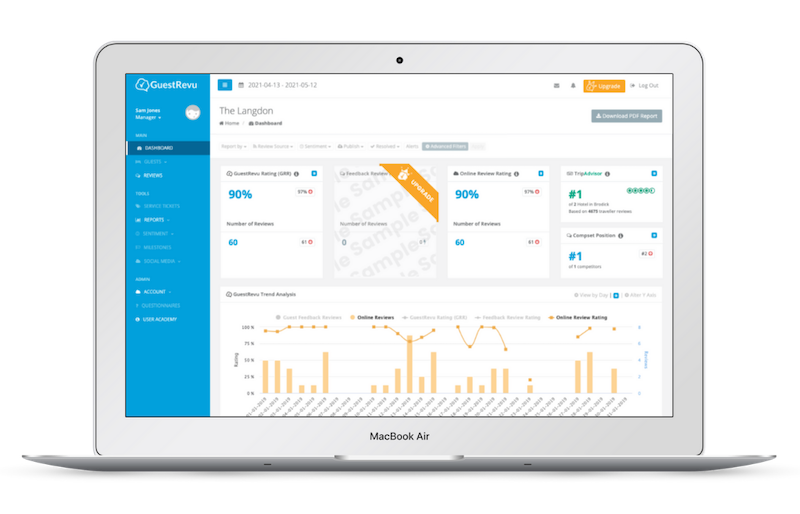
Reviews: “Reviews are becoming extremely important in terms of getting visibility on AI, and AI doesn't read reviews the same way that we do,” Adam explained. “So a 4.5-star average with one recurring complaint would actually be more damaging to the 4.2-star with consistent praise and well-handled issues.” Understanding what matters to guests, what recurring issues are surfacing, and then responding to reviews so that AI can see you’re working on it is vital for protecting your AI image. Luckily, GuestRevu has tools that can help.
Brand consistency: “This has been around for a while in search engine optimisation,” Adam confirmed, “but it's more important now, I would argue for AI because AI cross-checks information. So if your positioning, tone, or facts change depending on where AI looks, the confidence in your business and your brand drops.” AI hates uncertainty; it may well skip you and move on to the next option.
Strengthen machine readability (Structured content): “If AI can't clearly understand your website, it won't confidently recommend you,” says Adam simply. Schema markup, lots of structured content blocks like FAQs, and plain language all help AI to confidently parse your content.
Meaningless Metrics vs Real Money
We have several measures of success in hospitality (occupancy metrics, revenue metrics, guest satisfaction and reputation metrics, to name a few), and most have a place somewhere in the analysis of a business, but not all are relevant to every business.
“We have to know, very clearly: what is the product that we're offering? Who is our target guest? How are we delivering to that guest? And how do we measure success?” asserted Lionel Benjamin, CEO at Gullwing Hospitality.
“Investors today are far more savvy, far more focused on the financials, the returns,” explains Lionel. They are asking things like, “‘where do we spend our CapEx, and how does that really impact (believe it or not) the guest reviews?’ So they want to know: ‘are we sitting at 8 out of 10, are we 4 out of 5, where are we in that stack?’ and that's all driven by where they put their investment.”
There was a strong emphasis on moving past headline metrics and getting clearer about what actually drives profit, including profit per room sold and profit per square metre. Profitability is becoming more forensic, because sometimes metrics that look good on paper don't result in a better bottom line, and, as Lionel put it so succinctly, “I can’t bank the top line, I can only bank the bottom line.”
Thomas Greenall, CEO at Bespoke Hotels, shared an interesting anecdote about misleading metrics. “We've got a hotel [where] we did a small refurbishment. Its RevPAR is growing, it's outperforming the market, review scores are absolutely flying – it was pretty knackered, so Booking.com score was below 7. It is now doing really well, the Booking.com scores go to 8, so everything looks fantastic,” he explains. “However, all the business is now coming through Booking.com and the profits haven't moved forward since the refurb. So we've got to use all the metrics […] we've got to look at more metrics than just RevPAR.”
But many of the speakers reiterated that, as an industry, we should be more conscious (and conscientious) about the changing ways we measure our businesses and teams. Measuring success is one thing, but it only happens as a result of activities that create success – and that takes experimentation, and sometimes failure. “I would much rather sit around the table with a team of people that explain that they haven't met that KPI because they're trying something new,” Gavin Allison, Global Head of IT at Lore Group, assured the audience.
“I would much rather sit around the table with a team of people that explain that they haven't met that KPI because they're trying something new.”
– Gavin Allison, Global Head of IT at Lore Group
All in all, I’m delighted that Novacancy has added London to its list of venues, and not just because I was feeling left out whenever I saw something about the events in other time zones. The speakers were well chosen and even better delivered, and seeing real people say interesting, insightful things without AI was quite reassuring. More reassuring was the nuance all the industry leaders communicated.
Despite it sometimes seeming like there's a tech vs humans binary at play, the speakers and panellists at Novacancy all seemed to echo the same sentiment: if you’re honest about what makes your hospitality business special, and clear about how to protect that, then your technology, people and investments will all pull in the same direction.
*Yes, this is on Harry and Newton’s banned words list, but the alliteration was too good to pass up.